Presentation |
Development
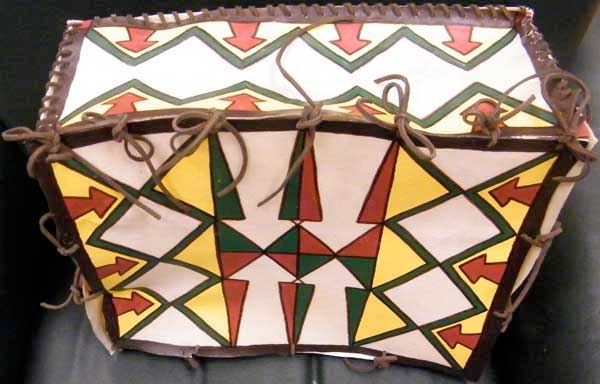
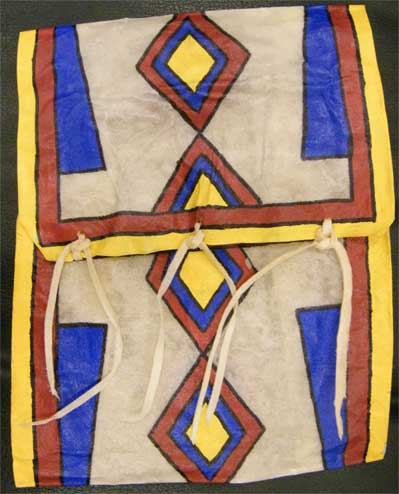
- Discuss with the students how the plains people of North America used parfleche bags to carry dried food, medicine, and personal items. A single piece of rawhide was folded into a case and tied shut with rawhide laces. The outside of a parfleche was decorated with geometrical shapes.
- Have the students examine the information in the references to learn more about parfleche and discover many examples.
- On an overhead or display show students the Angle Examples (Appendix A) and identify the specified angles as (1) acute, (3) obtuse, (3) reflex, (5) straight or (4) right.
- Ask for volunteer groups of 3 or 4 students to go to the display to identify other angles and categorize them.
- Divide the students into group of 4 or 5 and give each group a printed laminated copy of the parfleche box or the parfleche envelope (Appendix B) as well as an overhead pen, a referent and a protractor.
- Have one student in each group take the pen and when you say acute, obtuse, reflex, straight or right the student is to find an appropriate angle and mark it. Pass the pen to the next student in the group and repeat the process. Repeat as many times as feasible.
- Have each group wipe the laminated sheets clean.
- Have each student in each group, one at a time, use the referent and identify an angle, if one exists, that measures 45°, 90°, or 180°. The geometric designs on the parfleche are hand drawn so that the students should expect “imperfections” in angle construction.
- Have the groups exchange the parfleche images they have so that each group now has a different image. With the new image repeat the exercise in the previous bullet.
- Have each student in each group, one at a time, use the protractor to measure an angle on the parfleche image. Have another student in the group measure the same angle from a different orientation and see if the two measures are the same.
|