Activity/Lesson Ideas: |
- Discuss the significance of beads with the students. For example, beading has been an important part of First Nations culture for approximately 8,000 years prior to European contact. Beads were made of shell, pearl, bone, teeth, stone and fossil stems. Glass beads became a part of First Nation and Métis culture when the explorers came from Europe and brought seed and glass beads as trading items.
- Explain to students that each tribe distinct designs, patterns and approaches therefore collections of First Nations bead work art includes many different designs, styles, traditions and stitches. In Saskatchewan the Plains Cree uses a lot of symmetrical patterns and distinct geometrical shapes.
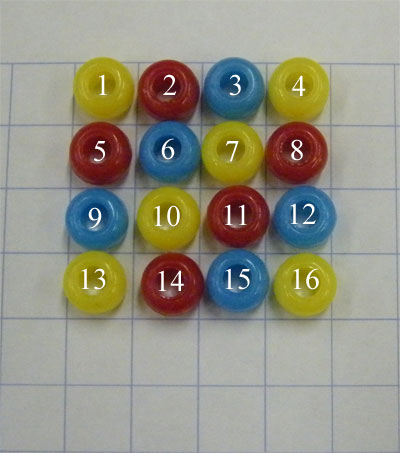
- Have the students use four columns on the graph paper to simulate the loom as explained in a previous lesson. Using colored markers, pencil crayons or pony beads have the students create the following pattern:
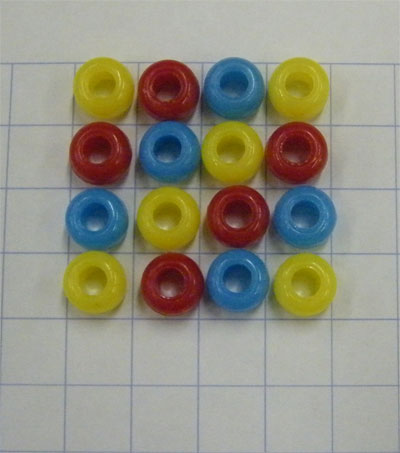
- Ask the students:
- If you continued the pattern and used 28 beads how many rows would you have on the loom? How many blue beads would you have on the loom?
- If you had 35 beads, how many rows could you make? How many beads would be left over? (Reminder.)
- Extensions
- Imagine if the beads were numbered,
- In what row is the bead number 30.
- In what row is the bead number 74? What color is the bead?
|